
The Section 1260H List of Chinese military companies (CMCs) has progressed from merely identifying CMCs to imposing real and significant impacts – on CMCs, but also on federal agencies and government contractors. Contractors must become familiar with how they will be impacted by 1260H List-related prohibitions and restrictions and begin analyzing and understanding their supply chains. Now. Contractors that do not understand and comply with legal limitations on doing business with entities on the 1260H List face significant exposure, which could lead to contract penalties or termination or worse, including criminal prosecution.
What is the Section 1260H List?
In section 1260H of the National Defense Authorization Act (NDAA) for Fiscal Year (FY) 2021, Congress directed the Department of Defense (DoD) to identify and maintain a list of CMCs operating directly or indirectly in the United States. Congress enacted section 1260H as part of its efforts to counteract China’s Military-Civil Fusion strategy – the government of the People’s Republic of China’s (PRC) initiative to integrate the country’s civilian, economic, and scientific sectors with the Chinese military to ensure the People’s Liberation Army (PLA) achieves technological and military superiority over the United States.
There are two key statutory criteria to determine whether an entity is eligible for inclusion on the 1260H List:
- The entity is operating directly or indirectly in the United States or any U.S. territories or possessions; and
- The entity is a CMC (Section 1260H(a) of the NDAA for FY 2021).
The first part of the 1260H List criteria is straightforward. The statute provides that “Operating directly or indirectly in the United States or any of its territories and possessions” includes “an entity selling goods in, or receiving goods or services from, the United States or any of its territories or possessions, regardless of whether the entity has a physical presence in the United States” (Section 1260H(g)(4) of the NDAA for FY 2021). Put simply, if an entity is transacting business with a U.S. entity or person, as either a buyer or seller, of either goods or services, the entity is operating directly or indirectly in the United States.
The statutory definition of a CMC is more challenging. Section 1260H broadly defines “CMC” as an organizational or other non-human entity that is: (a) directly or indirectly owned by, controlled by, affiliated with, or acting as an agent of certain Chinese governmental bodies/entities; or (b) a military-civil fusion contributor that provides commercial services, manufacturing, producing, or exporting (Section 1260H(g)(2) of the NDAA for FY 2021).
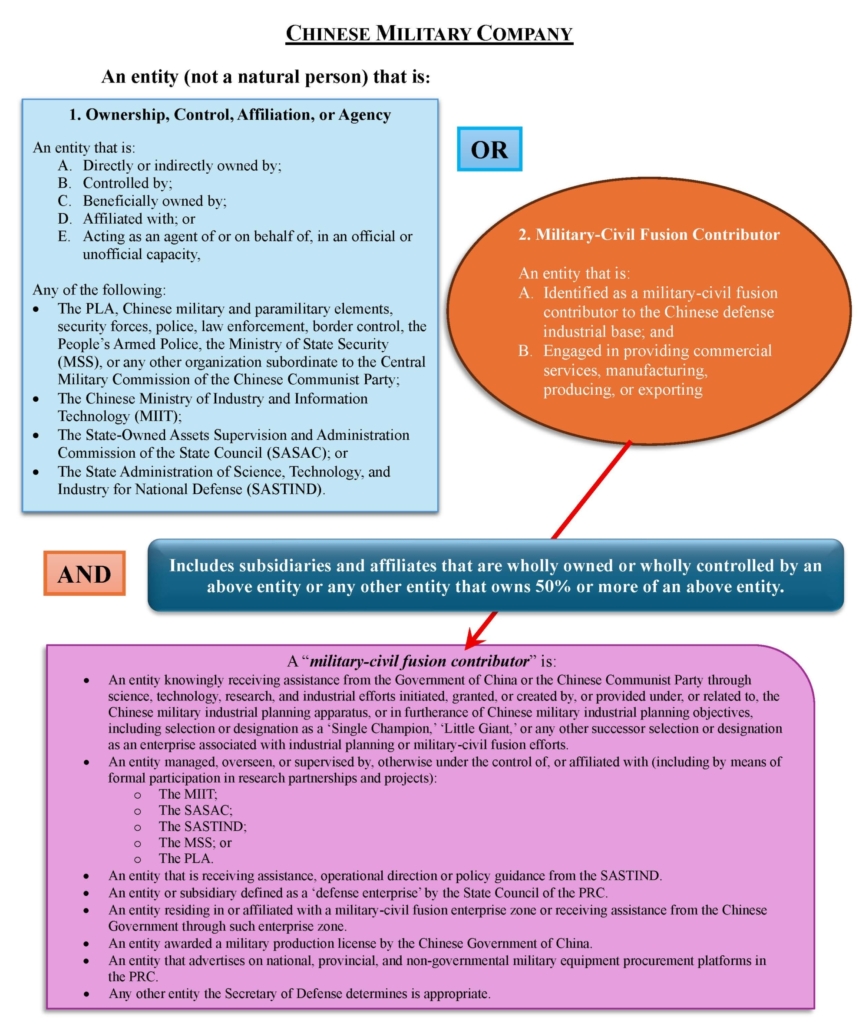
Once the Secretary of Defense identifies an entity as a CMC, the identified entity is added to the DoD’s 1260H List. The DoD is required to submit its 1260H List to Congress annually, in both classified and unclassified forms, and to publish the current version of the List in its unclassified form in the Federal Register. The Secretary of Defense must evaluate and add and remove entities from the 1260H List at least once a year, “based on the latest information available” (Section 1260H(b)(3)(A) of the NDAA for FY 2021).
How Section 1260H Impacts Federal Contractors
When the 1260H List was first enacted it hardly raised an eyebrow, functioning as no more than a “name and shame” tool. The list publicly identified companies as CMCs, but that was it. No specific consequences or effects stemmed from listing. Over the past five years, however, that has changed. Slowly but steadily, Congress has been increasingly imposing concrete legal consequences for 1260H-listed entities. Congress is employing the 1260H List as “blacklist” for federal procurement and eligibility for government funding opportunities (e.g., the funding under the CHIPS and Science Act of 2022 (Pub. L. 117-167) or the Infrastructure Investment and Jobs Act (Pub. L. 117-58)). In the not-too-distant future, 1260H-listed entities will not be allowed anywhere in the defense supply chain.
While companies may have decided that fighting placement on the list was not worth the money spent on the challenge in the early days of the 1260H List, that calculus is rapidly changing as inclusion on the 1260H List becomes a significant, perhaps insurmountable, burden to many listed companies that do business in the United States or with the U.S. Government.
Recent Legal Consequences of 1260H Violations
Recent 1260H List-related consequences include:
- The DoD cannot enter into, renew, or extend any prime contract or subcontract for goods, services, or technology with a 1260H-listed entity or any entity under a 1260H-listed entity’s control. Beginning on June 30, 2027, the DoD will no longer be permitted to allow entities on the 1260H List in its supply chains; the Department will not longer be allowed to procure goods or services that incorporate products or services produced or developed by a 1260H-listed entity or any entity under a 1260H-listed entity’s control. Section 805 of the NDAA for FY 2024, as amended by section 845 of the NDAA for FY 2026.
- The Department of Homeland Security is also prohibited from entering into a contract, memorandum of understanding, or cooperative agreement with any 1260H-listed entity. Section 536 of L. 118-47, the Further Consolidated Appropriations Act, 2024.
- The DoD cannot enter into a contract with any entity that contracts with any entity that engages in lobbying activities for any 1260H-listed entity. Section 851 of the NDAA for FY 2025 (codified at 10 U.S.C. § 4663).
- The DoD cannot contract for additive manufacturing machines from entities on the 1260H List (among others). Section 849 of the NDAA for FY 2026.
- The DoD is required to phase out computers and printers made or sold by 1260H-listed entities. Each FY, starting in FY 2026, the total percentage of computers and printers the DoD is allowed to purchase from 1260H List companies will decrease annually until FY 2029, when the DoD will be completely prohibited from acquiring any computer or printer manufactured, offered, or sold by an entity on the 1260H List or a subsidiary thereof. Section 850 of the NDAA for FY 2026.
- Once codified in the Federal Acquisition Regulation (FAR), federal agencies will be prohibited from acquiring biotechnology equipment or services from entities on the 1260H List; federal grants or loans may no longer be spent to buy or use biotechnology equipment or services from entities on the 1260H List; and contractors and subcontractors will not be allowed to use biotechnology equipment or services from entities on the 1260H List in performing federal contracts. Section 851 of the NDAA for FY 2026.
- Contractors are prohibited from using artificial intelligence products or software developed by entities on the 1260H List (among others) in performing DoD contracts. Section 1532 of the NDAA for FY 2026.
- The Intelligence Community is not permitted to contract with or purchase from biotechnology companies on the 1260H List. Section 6703 of the NDAA for FY 2026.
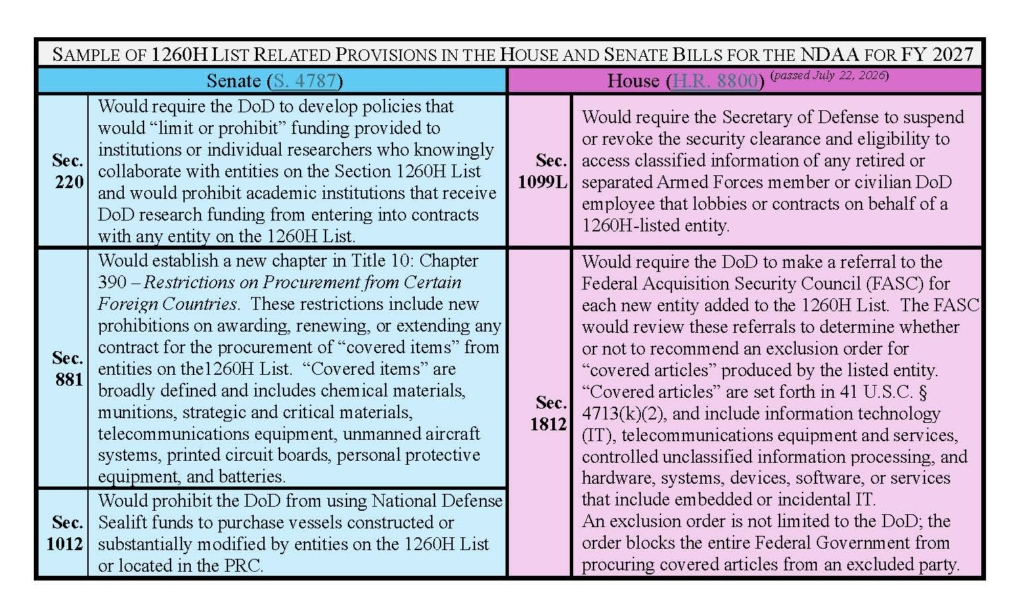
And Congress is not finished enacting statutory restrictions relating to the 1260H List. Both the House and Senate versions of the NDAA for 2027 (which has been stalled in the Senate since mid-July) seek to impose numerous additional restrictions on 1260H-listed entities that will continue to impact federal agencies and government contractors as well.
Supply Chain Compliance: What Contractors Must Do Now
The impact of the 1260H List is clearly not limited to listed entities or federal agencies. The 1260H List is rapidly transitioning into a high-stakes compliance boundary for government contractors. Contractors that fail to adequately screen for 1260H listed entities in their supply chains can find themselves disqualified from eligibility for awards, have contracts terminated, and face substantial exposure under the False Claims Act (FCA).
To protect themselves from inadvertently violating limitations and restrictions on engaging with or procuring from entities on the 1260H List, contractors should:
- Become experts in their own supply chains. Contractors will need to screen their business relationships to ascertain whether they are directly procuring goods or services from 1260H-listed entities and whether their suppliers, vendors, subcontractors, etc., are procuring such goods or services as well.
- Start exploring options to substitute or replace any goods or services from 1260H-listed entities in the supply chain as soon as they identify any potential problems. Contractors should especially consider developing alternative sources and be ready to account for long lead time items. Act as early as possible.
- Collaborate with the Government by proactively communicating with the contracting officer and other pertinent government officials about supply chain exposure to entities on the 1260H List, actions to avoid such exposure, what the Government can do to facilitate compliance with 1260H List-related restrictions, and if there are any 1260H-listed entity products or services that cannot be excised from the supply chain. Ask questions early and often.
- Engage and work closely with experienced counsel – such as Fluet’s attorneys – who understand both government contracting AND the 1260H List to develop compliance policies, audit supply chains, identify available solutions, and avoid violating the FCA.
As statutory restrictions around Section 1260H continue to expand, staying ahead of compliance requirements today ensures businesses remain competitive and protected tomorrow.


